
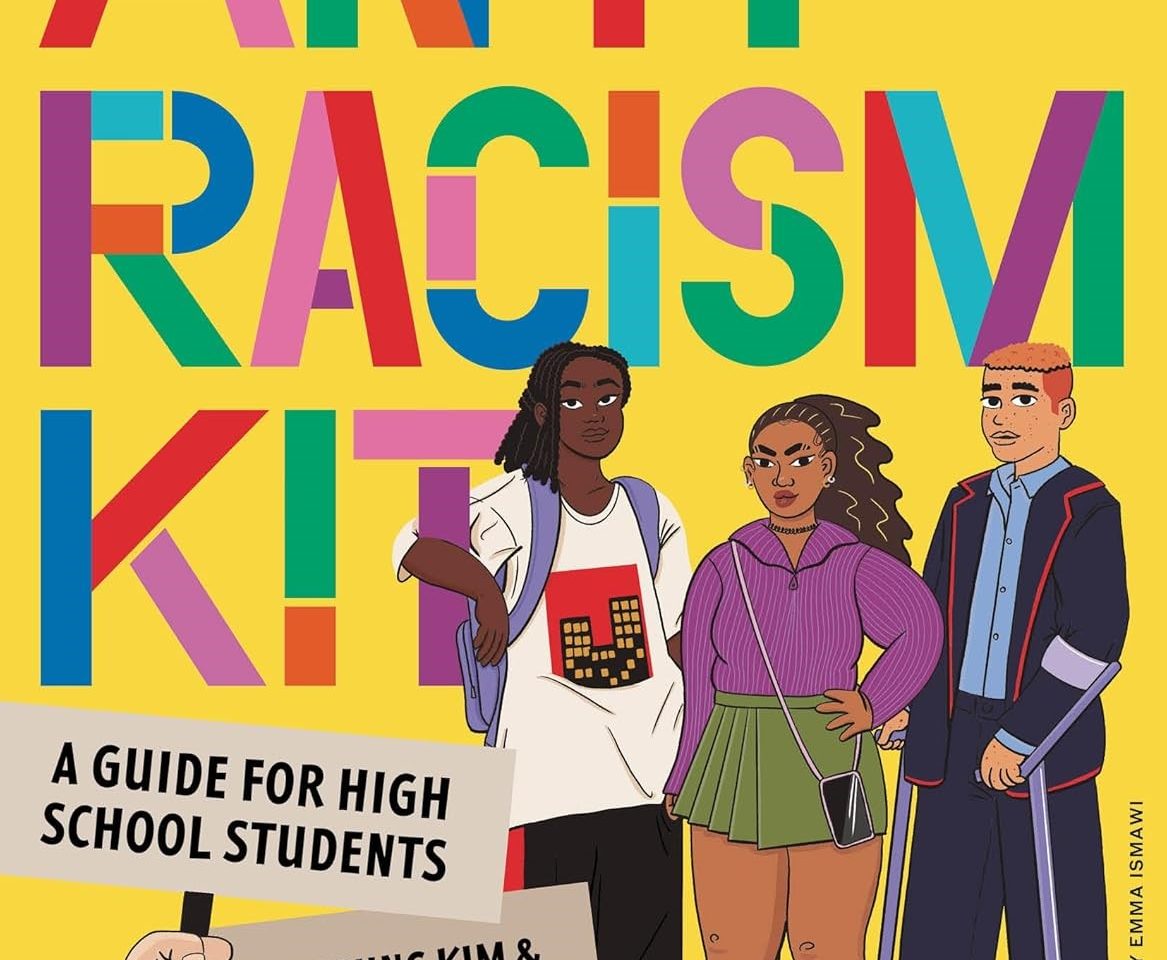

The Anti-Racism Kit: A Guide for High School Students (2024, Hardie Grant Books) forms a vibrant and barrier-breaking guide on navigating forms of racism in daily life. The book is written by young people for young people and, as a result, serves as an incredible grassroots educational tool that re-writes hierarchies and power dynamics.
Beginning as a 30-page Google Doc compiled by two high school students during COVID lockdowns, Jinyoung Kim and Sabina Patawaran set out to engender discussion surrounding the unique Australian experience of race amongst teenagers and young adults.
A vibrant and barrier-breaking guide on navigating forms of racism in daily life. The book is written by young people for young people and, as a result, serves as an incredible grassroots educational tool that re-writes hierarchies and power dynamics.
The Anti-Racism Kit brilliantly breaks down the theory of more scholastic works and conveys practical information surrounding forms of institutional and interpersonal discrimination with roots in colonialism.
The book is primarily written in an imperative form to guide a younger audience, but this is broken up by anecdotes and reassurances about lived experience. The lively art and stylistic features embody the better world strived for throughout the book, signifying a hopeful message of ‘If you can dream it, you can build it’.
There is beauty in the Anti-Racism Kit cultivated through the array of voices, colours, characters, experiences and perspectives portrayed. Everyone can find themselves in this book, and learning occurs hand in hand with representation.
It’s important to consider how racism, internalised racism and notions of reverse racism are rooted in systems of power. The Anti-Racism Kit studies how to see others as confined to systems with implicit social strata. Kim and Patawaran explore this deep issue with delicacy and joy when readers are encouraged to read selectively and take what they need from the guide. Beyond the contents page, a rainbow decision tree helps the reader identify where they may be less informed and points to sections of particular interest.
The authors delve into ‘Basics’, defining racism and all its different forms. A crucial point that the text explores is the systemic roots of ongoing racial disadvantage and how this could be ‘built into the system’. For example, the crucial difference between ’equity’ and ’equality‘ is addressed, as “with equality, everyone is given the same resources […] with equity, we acknowledge that people have different circumstances so we customise the resources we give to each person to that they can achieve the same outcome”.
The Anti-Racism Kit focuses on the micro and the macro of racial justice. Exploration of the self casts a spotlight on internalised racism, self-awareness and self-care. Major messages include phrases like ‘know thyself’ and ‘embrace your differences’. One anecdote recalls, “You also got bullied for your features, like having thick eyebrows and more body hair even though it’s normal. [Eventually], I became patriotic. I was just, like: ‘Egypt’s so cool. I’m literally descended from the pharaohs”. Here, the Anti-Racism Kit addresses discrimination and potential bullying and encourages strength and confidence in holding ethical views and acting on them.
One of the most powerful things education can do is provide a vocabulary for one to understand and relay one’s own experience. In addition to unpacking important terminology throughout, the Anti-Racism Kit ends with a glossary of terms related to race, colonialism and other aspects of social struggle. Jinyoung Kim and Sabina Patawaran have created a trailblazing tool for young Australians and adults worldwide.
This story was supported by Diversity Arts Australia’s StoryCasters program in partnership with The New Point Magazine. The views expressed within this story do not necessarily reflect the views of Multicultural NSW.
Explore other topics —
Other articles you might like...
View all
The internet was built to connect us — a digital space where distance was no barrier to connection. But somewhere along the way, the very platform designed to unite us began driving us apart.

A powerful new digital storytelling initiative is inspired by the real stories of resilience of Australian and New Zealander survivors of terrorism.
