
“A resilient society is one that actually withstands that threat of fear and hate and division and comes together united.”
That was the message from Dr Malcolm Haddon PSM during his evidence to the Royal Commission on Antisemitism and Social Cohesion, which was established following the Bondi Beach terrorist attack that killed 15 people on 14 December 2025.
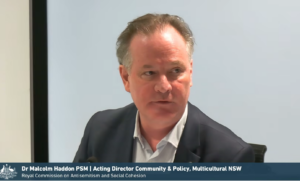
Dr Haddon, Acting Director of Community and Policy at Multicultural NSW, has worked in countering violent extremism policy and program development for around 15 years.
He told the Commission on 13 August that the threat from extremism was becoming more complicated, with extremists seeking to create divisions across racial, religious and, increasingly, gender and sexuality lines.
“Extremists hate Australia. Whether you’re a neo-Nazi white nationalist or an ISIS sympathiser or whatever it might be, you hate Australia,” he said.
“Our goal is to deny extremists what they want, which is fear, hate, division, and discord. To withstand that threat there needs to be a whole of society response.”
Dr Haddon told the Commission that multiculturalism has an important role to play in that response.
Australia’s cultural, linguistic and religious diversity can be targeted by people seeking to create division. But the relationships built across those differences can also make communities better able to withstand it.
“If the threat is to us as a society, then we collectively need to stand united against that threat,” Dr Haddon said. “If we succumb to fear, if we succumb to hate, if we succumb to division, that is not a resilient society.”
That thinking underpins Multicultural NSW’s COMPACT (Community Partnership Action) Program, which takes a different approach from programs working directly with individuals at risk of engaging in violent extremism.
Inspired by the way people came together after the Martin Place siege in 2014, the COMPACT Program instead focuses on how extremism can create divisions between communities and how they can be better prepared to withstand it.
Dr Haddon said some earlier approaches to countering violent extremism in Australia and overseas had stigmatised particular communities by trying to address social issues through a national security lens.
He explained that rather than asking particular communities to prevent terrorism, the COMPACT Program treats the divisive effects of extremism as a problem for everyone.
“Extremists are trying to divide us as a society. That’s up to all of us. There’s no particular community that is responsible for addressing that problem.”
If the threat is to us as a society, then we collectively need to stand united against that threat … if we succumb to fear, if we succumb to hate, if we succumb to division, that is not a resilient society.
COMPACT’s approach draws on research about resilience to natural disasters such as floods and bushfires. Communities prepare not only by trying to prevent disasters, but by building the relationships and resources that help them respond and recover when crises occur.
Dr Haddon argued that the same principle applies to social division: relationships across cultural, linguistic and religious differences need to be built before they are tested.
Young people have been central to that work, with more than 80,000 estimated to have participated in COMPACT projects since 2016.
“We look to young people as part of the solution for social cohesion, not part of the problem,” Dr Haddon said.
Projects have included All Together Now’s Agent C, which teaches young people to identify misinformation, racist conspiracy theories and fake news, and the Arab Council of Australia’s Reconnecting East and West, which brought young people from different parts of Sydney together following divisions that emerged during the COVID-19 pandemic.
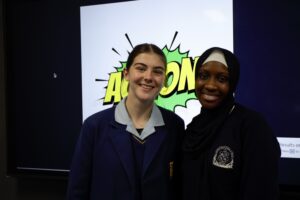
The current Interfaith School Communities program brings students from Catholic, Muslim and Jewish schools together to build relationships and learn about different faiths.
An independent evaluation of COMPACT’s 2021–2024 programs found 80 per cent of young participants felt they had learned about different perspectives and ways of life. It also found the program was creating lasting connections across cultural, ethnic and religious differences.
The more proactively we can actually build those strong relationships across cultural, linguistic, and religious differences, the better placed we will be when there are those divisive forces out there seeking to create ruptures and division within society.
-Dr Malcolm Haddon
For Dr Haddon, those connections are part of what makes a multicultural society more resilient when it comes under pressure.
“The more proactively we can actually build those strong relationships across cultural, linguistic, and religious differences, the better placed we will be when there are those divisive forces out there seeking to create ruptures and division within society.”
Explore other topics —
Other articles you might like...
View all
All Together Now worked with young people to design their own response to the manosphere and turn their ideas into the Unplug Hate campaign.
Thursday 22 January 2026 has been declared a National Day of Mourning to honour the 15 victims of the antisemitic terrorist attack at Bondi Beach. The day will be marked by a theme of light...
The internet was built to connect us — a digital space where distance was no barrier to connection. But somewhere along the way, the very platform designed to unite us began driving us apart.

Fake news and online conspiracy theories are flourishing. Here’s how young people are learning to spot the fakes and take a stand as digital citizens.
